



What Will the Upcoming Energy Regulations Mean for a Typical Post-War Multi-Residential Building?
In the coming years, the EU Directive on the Energy Performance of Buildings (EPBD) will be implemented into Swedish law. The Directive does not merely introduce stricter energy requirements for new constructions; it also represents a shift in how the energy performance of existing buildings is to be assessed, compared and developed over time. The emphasis moves away from isolated measures and measured operational outcomes towards more function-based requirements, normalised calculation methods and a clearer focus on long-term planning.
In this context, the Swedish National Board of Housing, Building and Planning (Boverket) has circulated for consultation a new regulatory package that will gradually replace parts of the current Building Regulations (BBR) and the regulations on energy calculations (BEN). Boverket’s proposal for regulations on energy conservation.
At the core of the proposals are new, more modular provisions on energy efficiency, including a revised method for calculating energy performance. The modular structure is designed to allow for stepwise tightening of requirements, clearer application in cases of alteration and refurbishment, and a formalised adjustment mechanism whereby requirement levels are to be assessed against the building’s actual technical and economic conditions. It is important to state clearly that the new provisions will not in themselves impose mandatory energy renovations on property owners. What lies further ahead, however, are national obligations on Member States to stimulate energy renovation through various forms of support and incentives directed at owners of the least energy-efficient building stocks.
Boverket proposes that the new provisions should enter into force progressively from 2026 onwards, with different dates depending on regulatory area and application. For new buildings, the ambition is early implementation, whereas alteration and refurbishment measures may in certain cases be subject to transitional provisions. At the same time, it is clarified that existing buildings will increasingly be assessed according to a coherent energy logic rather than through isolated measures.
Before examining how the new calculation model affects a typical multi-residential building from the 1960s and 1970s, it is important to understand the broader context of the change. This is not simply a matter of introducing a new energy figure or adjusting a calculation rule. It represents a broader shift in how energy performance is used as a regulatory instrument – from verifying achieved values to serving as a tool for planning, prioritisation and long-term development of the building stock.
Against this background, there is a clear need to translate regulatory principles into practical consequences for existing buildings. This Insight article therefore takes as its starting point a typical Swedish multi-residential building from the 1960s–70s and analyses how the new energy performance method alters the assessment of the building, the choice of measures, and the requirements for documentation and planning. The perspective is methodological rather than normative. The focus lies on how to build a coherent and long-term decision-making framework as regulation moves from measure-driven to function- and planning-driven governance.
Starting Point: A Typical 1960s–70s Multi-Residential Building
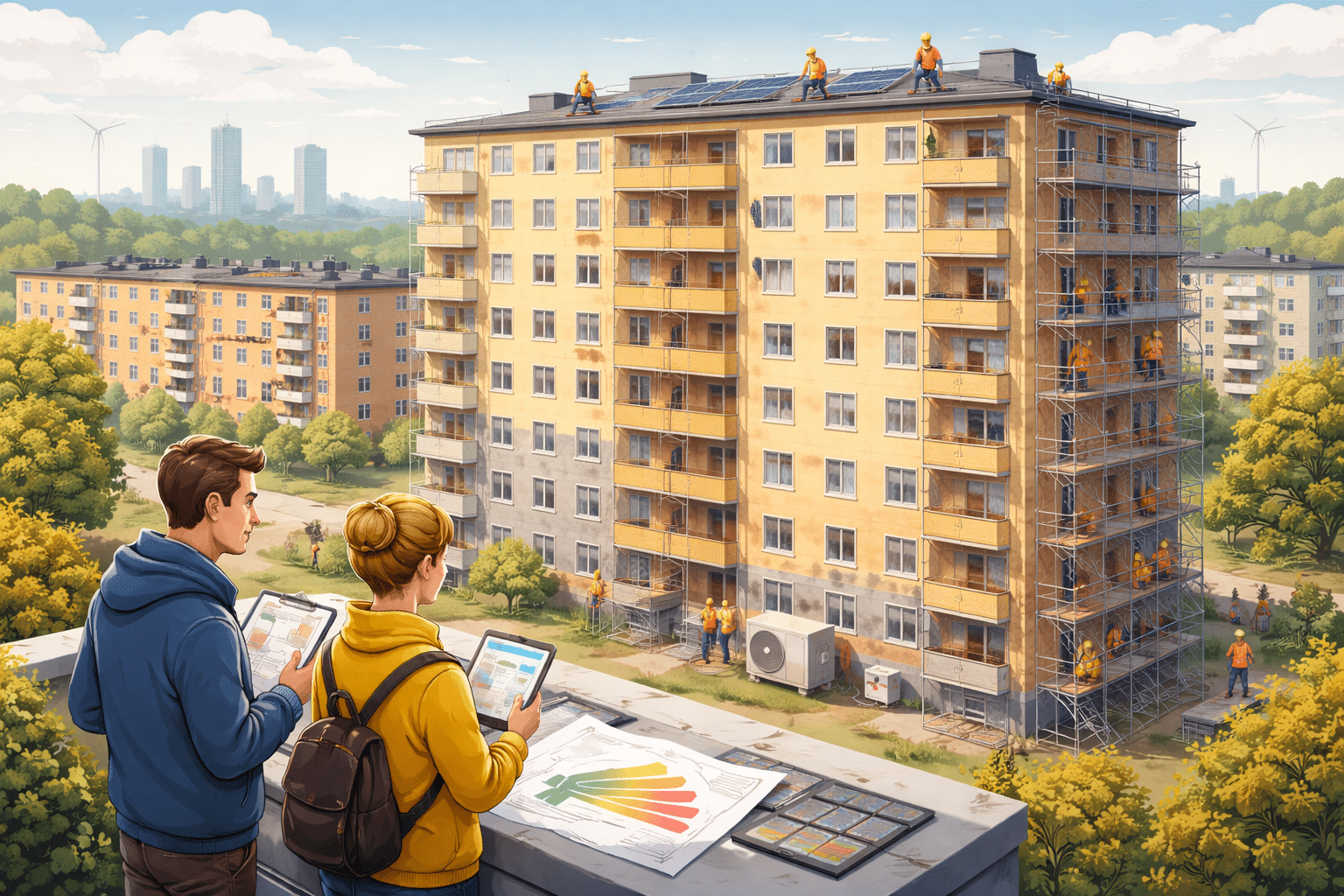
Our reference building is a multi-residential property constructed around 1970, with district heating as the primary heat source, mechanical extract ventilation (F) or early heat-recovery ventilation (FTX) in some parts, and a thermal envelope broadly reflecting the standards of the period. The building is well maintained but has not undergone comprehensive energy renovation. Windows may have been replaced in stages, and the attic may have received additional insulation, but façades and structural systems remain largely unchanged.
Under the current regulatory framework, such a building often occupies an intermediate position: not technically deficient, yet far from meeting present-day new-built standards. At the same time, this building type represents a very large share of the Swedish housing stock, making its treatment central to the implementation of the EPBD.
How Is the Building Assessed Under the Current Method?
Under the present BBR and BEN logic, a building’s energy performance is primarily assessed through a composite indicator based on delivered energy per square meter per year, adjusted using weighting factors. The result is influenced not only by the building’s technical characteristics but also by actual operation, control strategies and occupant behaviour, particularly regarding indoor temperatures and domestic hot water use.
In practice, this means that two fundamentally similar buildings may receive different energy performance results depending more on how they are operated than on how they are constructed. For a 1960s–70s building, relatively limited measures – such as operational optimisation, system balancing or supplementary photovoltaic installations – may yield an apparently acceptable energy figure, even though the building’s underlying energy demand remains largely unchanged.
The New Method: A Different Perspective
Under Boverket’s proposed provisions, this perspective changes fundamentally. Energy performance is to reflect more clearly the intrinsic energy demand of the building and its technical systems, calculated under standardised and normalised assumptions (so-called category-typical values). Indoor temperatures, domestic hot water use and operational conditions are more explicitly fixed within the method, reducing the impact of individual usage patterns.
For our reference building, the focus thus shifts from how little energy happens to be delivered in practice to how much energy the building actually requires to function as housing under specified input conditions. Electricity is not considered solely in terms of kilowatt-hours but also in relation to peak power demand. On-site solar electricity is not treated as an isolated addition capable of compensating for high base consumption, but rather in relation to the building’s overall energy balance.
What, Then, Happens to the Building?
Under the new method, a clearer pattern emerges. The building exhibits a relatively high heat demand per square meter compared with newer buildings, ventilation systems with limited heat recovery, and a thermal envelope where further improvements often require extensive interventions. These characteristics become more difficult to obscure through operational assumptions or supplementary technical installations.
This does not mean, however, that the building is automatically deemed inadequate or that extensive measures are required. Rather, it becomes clearer which aspects of energy performance are structural and which can reasonably be influenced through proportionate interventions.
Unprofitable Measures and the Adjustment Mechanism
In this context, Boverket’s ambition to minimise the risk of economically unjustified measures becomes concrete. For buildings of this type, certain technically possible interventions – for example very extensive thermal envelope upgrades or full system replacements requiring major alterations to functioning installations and living environments – may be difficult to justify from a long-term economic perspective.
The new regulatory model is not designed to force such measures automatically. Instead, it introduces a clearer adjustment mechanism, whereby requirement levels are to be assessed against the building’s technical, economic and functional conditions. Crucially, this assessment cannot take place implicitly. The reasoning must be explicit, documented and traceable over time – precisely the role envisaged for an energy renovation plan.
Planning Over Time as a Governing Principle
For the 1960s–70s building, this represents a clear shift in approach. Instead of focusing on which measures must be implemented immediately, the central question becomes how the building’s energy performance can be improved stepwise and rationally over time, in alignment with natural maintenance cycles and technological development.
Here, the new calculation method connects naturally with structured energy renovation planning. For older multi-residential buildings, this may mean postponing certain measures, combining them with future refurbishments, or replacing them with alternative solutions that yield a better overall effect, without locking the property into costly or short-term decisions.
Implications for Property Owners
For owners and managers of multi-residential buildings from the post-war expansion period, the new regulatory model does not necessarily imply stricter requirements, but it does impose clearer expectations regarding analysis, structure and forward planning. It will be less sufficient to demonstrate that the energy performance indicator happens to fall within acceptable limits. It becomes more important to explain why certain measures are implemented, why others are not, and how the building’s energy performance is intended to develop over time.
In return, the risk of being compelled to undertake technically correct but economically questionable measures is reduced – provided that the property owner can present a coherent and well-founded decision-making framework.
Summary
For the large stock of 1960s–70s buildings, the new energy performance method represents a shift from short-term optimisation to long-term understanding. The regulatory framework becomes less measure-driven but more demanding in terms of analysis, documentation and strategic planning. It is in this light that Boverket’s ambition to modernise the regulatory structure while reducing the risk of unprofitable measures should be understood.
For property owners working methodically and with a long-term perspective, this may mean greater freedom of action – but also clearer responsibility for how the building’s development towards improved energy performance is justified and planned.
In short: more reliance on sound judgement throughout.