



Raising a multi-family building from energy class E to B requires a combination of building-technical and installation-technical measures. The optimal path depends on the building type, existing systems, and the synergies that arise when measures are combined. Below is an overview and comparison between two common scenarios:
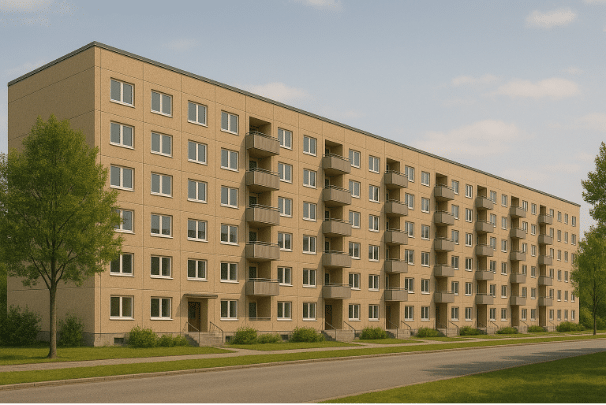
- A Million Programme building with a concrete structure and mechanical exhaust ventilation. The building is heated with district heating and the windows are original 2-pane.
- A Functionalist (Funkis) building with natural ventilation and a rendered façade. The building is heated with district heating, and the windows were replaced in 2010. The property has smart controls and maintains stable indoor temperatures.
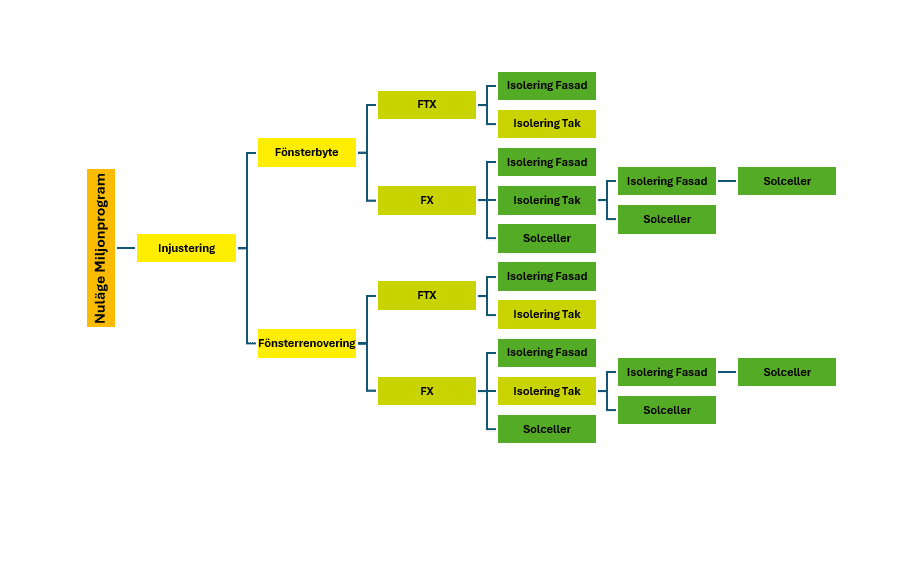
After this overview, a simulated pathway is made in BIM Energy to identify the most cost‑effective path toward achieving energy class B.
| 1. Additional Façade Insulation | |
|---|---|
| Advantages | Disadvantages |
Significantly reduces heat loss, often the building’s single largest energy demand. |
High cost and strong impact on the building’s appearance, particularly sensitive for functionalist buildings. |
Improves indoor climate and provides more even wall temperatures. |
Requires moisture‑safe design, especially for rendered or historically valuable façades. |
Can be combined with new façade cladding or renovation. |
|
| 2. Roof Insulation | |
|---|---|
| Advantages | Disadvantages |
Low‑cost measure with high impact, especially for attic spaces. |
Limited effect if the roof has already been upgraded. |
Minimal impact on building aesthetics. |
Requires assessment of moisture risks. |
| 3. Window Replacement | |
|---|---|
| Advantages | Disadvantages |
Significantly improved U‑value and indoor comfort. |
High cost. |
Can reduce noise and drafts. |
Changes the façade appearance. |
Increases building airtightness, requiring improved ventilation! |
|
| 4. Window Renovation | |
|---|---|
| Advantages | Disadvantages |
Considerably cheaper than full window replacement. |
Does not provide the same energy savings as new windows. |
Can be supplemented with interior energy glass panes. |
Requires high‑quality craftsmanship. |
Preserves the building’s architectural character. |
|
| Compare window renovation and window replacement – what suits your building best? | |
| 5. Heating System Balancing | |
|---|---|
| Advantages | Disadvantages |
Very cost‑effective measure. |
Limited actual energy savings if the system already works reasonably well. |
Equalizes heat distribution and reduces overheating. |
|
Often required for optimal heat pump performance. |
|
| 6. HRV (Supply and Exhaust Ventilation with Heat Recovery) | |
|---|---|
| Advantages | Disadvantages |
Large energy savings through heat recovery (40–95% of ventilation losses). |
High installation cost. |
Improved indoor climate and filtered supply air. |
Requires space for ductwork. |
| 7. Exhaust Air Heat Pump (EAHP) | |
|---|---|
| Advantages | Disadvantages |
Recovers energy from exhaust air in buildings with mechanical ventilation. |
Less comfort and control compared to HRV. |
Lower cost compared to HRV. |
Not suitable for natural‑ventilation buildings without major ventilation upgrades. |
Provides both domestic hot water and heating. |
|
| 8. Heat Pump | |
|---|---|
| Advantages | Disadvantages |
Large heating savings and can replace oil or district heating. |
High investment cost. |
Stable operation and long service life. |
Requires permits and space for e.g. boreholes. |
| 9. Solar Panels | |
|---|---|
| Advantages | Disadvantages |
Generates electricity for heat pumps, building electricity, or charging infrastructure. |
Limited roof space. |
No direct heat saving, but reduces purchased energy. |
|
| Read about how solar energy becomes solar power in our guide | |
| 10. Wastewater Heat Recovery | |
|---|---|
| Advantages | Disadvantages |
Recovers heat from shower and wastewater, reducing hot water energy demand. |
Installation cost and space requirements in shafts/technical rooms. |
Well suited for buildings with high and consistent hot water usage. |
Requires maintenance/cleaning to maintain performance. |
Interactions and Synergies Between Measures
Building Envelope Synergies
- Façade + roof + windows provide large combined savings, although at high cost if not part of planned maintenance.
- A tighter building envelope requires improved ventilation to avoid moisture and high CO₂ levels.
Ventilation and Heat Pumps
- Ventilation upgrades often require major interventions and depend heavily on the building layout, number of apartments, and existing shafts.
- Heat pump sizing depends on power demand, making it important to calculate the effects of other measures first.
Solar Panels as Reinforcement
- Solar panels combined with a heat pump provide high profitability by reducing purchased electricity for heat pump operation.
Balancing as a Base Measure
- Proper system balancing should always be performed, especially when planning major envelope improvements.
Differences Between Million Programme Buildings and Functionalist Buildings
Million Programme Buildings
- Large heat losses mean insulation improvements have strong impact.
- Mechanical exhaust ventilation makes EAHP or HRV relatively easy to implement.
- Standardized construction simplifies planning of measures.
Functionalist Buildings
- Natural ventilation requires ventilation upgrades for good indoor climate.
- Window frames and architectural style often make window renovation preferable over full replacement.
Simulation and Optimization in BIM Energy
Simulation is crucial when many measures can be combined. BIM Energy is especially useful because it:
1. Allows Testing of Measure Packages
Examples:
- “Window replacement + balancing + HRV”
- “Façade insulation + geothermal heat pump”
- “Roof insulation + EAHP + solar panels”
The program calculates:
- Energy use (kWh/m²·year)
- Power demand
- Savings
- Indoor climate
- Economic consequences, and more
2. Identifies Synergies
In BIM Energy you can see how:
- HRV and envelope measures reduce the required heat pump size
- Solar panels reduce purchased electricity needed for heat pump operation
3. Enables Step‑by‑Step Optimization
You can create:
- Renovation scenarios spanning 1–50+ years, suitable for EU EPBD requirements.
- Comparisons of investment levels versus energy class targets
Example: Million Programme Building
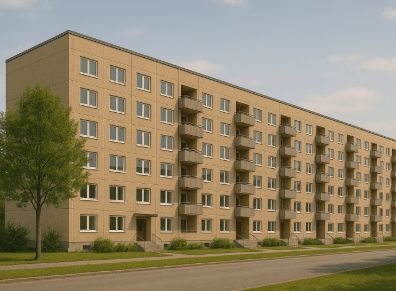

The building has:
- Mechanical exhaust ventilation.
- District heating.
- Original 2‑pane windows.
- Heating control losses of 2°C.
Based on these conditions, a path forward can be defined. Balancing should be done after renovations are completed, but since major control losses exist today, it is considered a “must‑do” measure. Windows must also be addressed, either through full replacement or renovation with an additional insulating pane.
Since the ventilation has no heat recovery, it is relevant to examine which technology—EAHP or HRV—is most suitable. Additional envelope measures may also be evaluated, as well as solar panels if EAHP is chosen.
The most cost‑effective path to energy class B in this case is: Balancing → Window renovation → EAHP → Solar panels. In this specific scenario, the payback time is approximately 15 years and the measures involve relatively simple interventions with lower investment costs than other alternatives.
Example: Functionalist Building
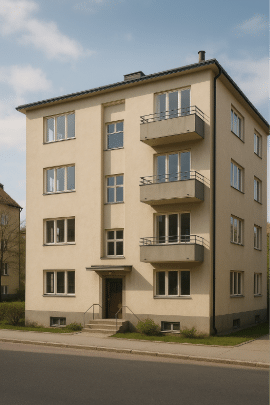

The building has:
- Natural ventilation.
- District heating.
- Relatively modern 3‑pane windows.
- Balancing already completed.
For the functionalist building, ventilation is the major challenge that cannot be avoided. Natural ventilation worked well when the building had a high‑temperature heating system, which created stronger thermal draft. We compare paths involving HRV and EAHP. Then we evaluate additional relevant measures such as façade and roof insulation, as well as heat pumps for scenarios with HRV.
In this case, it is difficult to reach energy class B without considering heat pumps. However, it should be noted that insulation type and thickness can be analyzed in further detail in BIM Energy to achieve the desired result.
Summary
Achieving energy class B from class E requires a strategic combination of measures. Every building has its own conditions and opportunities!
With BIM Energy you can simulate different packages, identify optimal synergies, and plan a cost‑effective and technically robust renovation.